
Healthy Recipes
PCRM Food For Life Recipes
Certified Food For Life Cooking Instructor, Sari Dennis is also a Board Certified Health and Wellness Counselor, and Founder of My Wellness Counts, LLC. Sari works with professionalism and compassion, guiding her clients to prioritize their health by connecting sound nutrition with healthy lifestyle choices. Sari advocates the value of nutritional excellence as a path to vibrant health and happiness.
“Healthy surroundings create healthy thoughts, and healthy thoughts inspire healthy choices.”
Sari works in group-settings and one-on-one with individual clients, over the course of a 6-month period. Sari received her training at the Physicians Committee For Responsible Medicine and at the Institute for Integrative Nutrition in NYC. Sari is certified by Purchase College of the State University of New York (SUNY), and accredited through the American Association of Drugless Practitioners (AADP).
Below you will find easy ways to REPLACE your allergy-sensitive ingredients for healthy, plant-based options . . . so keep reading!
All recipes are 100% plant-based, and here are some of the many health related reasons why:
20 Quotes from the Experts
1. “Genetics loads the gun, lifestyle pulls the trigger.” – Caldwell Esselstyn, Jr., MD
2. “They say that vegetable food is not sufficiently nutritious. But chemistry proves contrary. So does physiology. So does experience…And again: the largest and strongest animals in the world are those which eat no flesh-food of any kind – the elephant and rhinoceros.” Russell Trall, MD
3. “It is the position of the American Dietetic Association that appropriately planned vegetarian diets, including total vegetarian or vegan diets are healthful, nutritionally adequate, and may provide health benefits in prevention and treatment of certain diseases.” ADA Position on Vegetarian Diets 2009
4. “Your choice of diet can influence your long term health prospects more than any other action you might take.” – Former Surgeon General C. Everett Coop
5. “You cannot buy health; you must earn it through healthy living.” – Joel Furhman, MD
6. “We have science to suggest that if you can make three changes – give up meat, all dairy, and refined foods including free oils – you can avoid dying form cancer and heart disease.” Mehmet Oz, MD
7. “People feel poorly because they are nourished by foods you wouldn’t feed to your dog or cat. The rich western diet is full of fat, sugar, cholesterol, salt, animal protein — all the wrong foods for people. Look around the world and see where people are thin and healthy — they live on a starch based diet — rice.” – John McDougall, MD
8. “Heart disease is a food-borne illness.” – Caldwell Esselstyn, Jr., MD
9. “In this diet you’re never hungry. You never have to count calories. Its like quitting smoking, you don’t eat meat for a while and it’s hard for the first day or two, but (it’s easier) after you focus on the new foods you’re eating.” – Neal Barnard, MD
10. “A plant-based diet is more likely to produce good health and to reduce sharply the risk of heart problems, cancer, diabetes, osteoporosis, gallstones, and kidney disease.” – T. Colin Campbell, PhD
11. “An important fact to remember is that all natural diets, including purely vegetarian diets without a hint of dairy products, contain amounts of calcium that are above the threshold for meeting your nutritional needs…In fact, calcium deficiency caused by an insufficient amount of calcium in the diet is not known to occur in humans.” – John McDougall, MD
12. “We should all be eating fruits and vegetables as if our lives depend on it – because they do.” – Michael Greger, MD
13. “…in switching over to a plant-based diet, most people are able to reverse their heat disease, cure type II or significantly improve type I diabetes, effortlessly reduce their weight, eliminate their chronic and nagging aches and pains.” – Alona Pulde, MD and Matthew Lederman, MD
14. “I don’t understand why asking people to eat a well-balanced vegetarian diet is considered drastic while it is medically conservative to cut people open or put them on powerful cholesterol-lowering drugs the rest of their lives.” – Dean Ornish, MD
15. “We believe that if people focus on what they’re eating and not how much they’re eating, they will have weight loss with a plant-based diet.” – Neal Barnard, MD
16. “In the next ten years, one of the things you’re bound to hear is that animal protein is one of the most toxic nutrients of all that can be considered. Quite simply the more you substitute plant foods for animal foods, the healthier you are likely to be.” – T. Colin Campbell, PhD
17. “Medicines cannot drug away the cellular defects that develop in response to improper nutrition throughout life.” – Joel Furhman, MD
18. “Poor nutrition trumps tobacco, alcohol, and sedentary lifestyles as the primary cause for the development of chronic illnesses. We cannot ignore the reality that what we eat is totally within our control, and our choices are what determine the level of risk we have of becoming ill.” – Baxter Montgomery, MD
19. “The beef industry has contributed to more American deaths than all the wars of this century, all natural disasters, and all automobile accidents combined. If beef is your idea of “real food for real people” you’d better live real close to a real good hospital.” – Neal Barnard, MD
20. “Numerous research studies have shown that cancer is more common in populations consuming diets rich in fatty foods, particularly meat, and much less common in countries with diets rich in grains, vegetables, and fruits.” – Neal Barnard, MD
Bonus: “The fat you eat, is the fat you wear.” – John McDougall, MD
Therefore: eat more plants!
Replacing Allergy-Sensitive Ingredients
The following is a rundown of what to use in place of allergenic ingredients, including gluten. These allergen-free standbys are wonderful in the kitchen.
Replacing Eggs
Eggs provide moisture, richness, binding, and leavening. You may choose from a variety of alternate ingredients throughout your recipes in place of eggs.
APPLESAUCE
Applesauce works as a binding agent, and is also a great substitute for eggs or oil/shortening, when you want to reduce the fat. 1/4 cup unsweetened applesauce = 1 egg
BANANA
Works similarly to applesauce, but has a much more distinct flavor. Only use it when you want to taste banana. 1/2 a mashed banana = 1 egg
PRUNE PUREE (AKA, baby food!)
Again, works similarly to applesauce, with a sweeter flavor. 4 1/2 to 5 ounce jar = 1 egg
VEGAN YOGURT
Vegan yogurt is great for adding moisture and binding. You may use it in place of eggs, but also in place of buttermilk, or cream. Also, coconut milk yogurt (see notes below re: coconut), and rice milk yogurt. Most people with tree nut allergies are NOT allergic to coconut, it’s an extremely rare allergy, but still, check with your allergist before consuming it. If the coconut milk is not an option for you, use the rice milk yogurt instead. 1/4 cup vegan yogurt = 1 egg
FLAXSEED MEAL
I love the effect of “flax eggs”, it works just like an egg, doing everything but leavening. It’s moist, rich, and binding. However, use “flax eggs” sparingly, as it is difficult to find totally clean flax. It’s often processed in facilities along with tree nuts or other allergens. So be sure to check with the manufacturer before consuming flax if cross contamination is a concern for you. 1 tablespoon Flax Seed Meal mixed with 3 tablespoons warm water = 1 egg
EGG REPLACER
Egg Replacer is great for leavening and binding. Ener-G Egg Replacer is manufactured in a facility free of all common allergens. 1 1/2 teaspoons Ener-G Egg Replacer mixed with 2 tablespoons rice milk or water = 1 egg
BAKING SODA & VINEGAR
This is an old baking trick from WWII when eggs were rationed. It provides leavening in place of eggs. Add the baking soda to the dry ingredients, and the vinegar to the liquid. Wait to combine the dry and liquid ingredients until the very last minute, as the chemical reaction occurs as soon as the baking soda and vinegar meet, and you must get your goodie straight into the oven! 1 teaspoon baking soda + 1 teaspoon cider vinegar (or distilled white vinegar) = 1 egg
Replacing Dairy
Replacing cow milk is pretty much a no-brainer since even our local supermarkets now sell soy milk, hemp milk, almond milk, pea milk, seed milk, rice milk, coconut milk, etc.
1 cup non-dairy milk = 1 cup cow milk
RICE MILK
Rice milk is generally made from brown rice. It is a little thinner than other nondairy milks, but still provides yummy moistness. Rice milk is commercially available just about everywhere. Be sure to read ingredients carefully, as some rice milk brands contain gluten.
HEMP MILK
Hemp milk is the most nutritious of nondairy milks, and has a rich “nutty” flavor. Look for it at Whole Foods or your local health food store.
COCONUT MILK
Traditional coconut milk is very rich. It can be used in baking, but bare in mind that it is thick and sweet. (Again, the allergy world is on the fence about coconut. Some say it’s a member of the date family, some say it’s a tree nut. Most people with tree nut allergies are not allergic to coconut, it’s an extremely rare allergy, but still, check with your allergist before consuming it).
There is also a new Coconut Milk on the shelves made by Turtle Mountain, that functions like rice milk. It’s a thinner, lower calorie coconut milk, available in the refrigerated section at Whole Foods. It’s amazing for baking and yummy in cereal!
INSTEAD OF BUTTERMILK
You can easily make your own nondairy buttermilk at home. For any 1 cup of buttermilk, add 1 tablespoon lemon juice or cider vinegar to 1 cup nondairy milk, and let stand about 10 minutes to sour.
INSTEAD OF YOGURT, CREAM & SOUR CREAM
Use coconut milk yogurt, and rice milk yogurt in place of yogurt, cream, and sour cream. The coconut milk yogurt has a better texture, and the tang of traditional dairy yogurt. If the coconut milk is not an option for you, use the rice milk yogurt instead. And if you can eat soy, then by all means, substitute soy yogurt.
INSTEAD OF BUTTER
Ah, butter, the backbone of western baking. Or is it? I’ve been delighted to find you can still make awesome “buttery” baked goods WITHOUT butter.
DAIRY-FREE, SOY-FREE VEGETABLE SHORTENING
It’s non-hydrogenated, cholesterol free, and bakes up nice and light. 1 cup dairy-free, soy-free vegetable shortening = 1 cup unsalted butter
Replacing Nuts & Nut Butters
SUNBUTTER
The past few years has seen the advent of Sunbutter. Sunbutter (aka, sunflower seed butter) is a great replacement for peanut butter and other nut butters. It is available at Trader Joes, Whole Foods, and many local health food stores. It’s also popping up on some supermarket shelves. Additionally, you can now buy safe sunflower seeds for snacking, or use in baking, though you may have to order these online.
Replacing Wheat Flours & Other Gluten Flours
This is perhaps the trickiest part of baking allergen-free. It’s not so hard to bake gluten-free if you can still use eggs, butter, and nut flours, but learning to bake without ANY of them can be a challenge.
GLUTEN-FREE, ALLERGEN-FREE FLOURS
Rice, Corn, Potato, Tapioca, Beans, Garfava, Sorghum, Quinoa, Millet, Buckwheat, Arrowroot, Amaranth, Teff, Montina, and Flax.
Whoa, that’s a lot of flours! And trickier still, most of them can’t be used on their own, they must be mixed like you’re doing AP chemistry. They can’t be swapped out cup for cup for wheat flour, and they require varying amounts of xanthan from recipe to recipe. So to make things simple for YOU, here is a Basic Gluten-free Flour Mix that you can whip up and store in your fridge:
BASIC GLUTEN-FREE FLOUR MIX (RECIPE)
Makes 6 cups
4 cups superfine brown rice flour
1 1/3 cups potato starch (not potato flour)
2/3 cup tapioca flour (also called tapioca starch)
1. To measure flour, use a large spoon to scoop flour into the measuring cup, then level it off with the back of a knife. Do NOT use the measuring cup itself to scoop your flour when measuring! It will compact the flour and you will wind up with too much for the recipe. Combine all ingredients in a gallon-size Ziploc bag. Shake until well blended. Store in refrigerator until ready to use.
A FEW WORDS ABOUT CHOICE OF FLOURS
When preparing baked goods recipes, do so with a blend of super-fine brown rice flour, potato starch, and tapioca flour. These selected flours/starches are great for gluten-free baking, and they are generally the easiest gluten-free flours for the general public to find. But most importantly, they carry the least risk of cross contamination.
Most gluten-free flours are still being processed in the same facilities as tree nut flours (such as almond flour). These ingredients can be found with the safety assurance that they are free from cross contamination with all common allergens, and which are easily found by the general public.
A FEW WORDS ABOUT EGG REPLACER
Egg replacer works best when whisked together with a liquid, using a small whisk. Be sure to beat it until slightly frothy and all the lumps have dissolved before adding it to a recipe.
A FEW WORDS ABOUT XANTHAN GUM
Xanthan Gum is the be-all and end-all of gluten-free baking. I don’t know what we would do without it. It is a plant gum that mimics gluten. It provides structure and elasticity. A little bit goes a long way, so measure it carefully. I have found there is variation between brands. I like Ener-G Xanthan Gum best. It is a derivative of corn. If you can’t eat corn, you may use guar gum instead, but please note, these recipes have not been tested with guar gum.
Breakfast
Lunch
Dinner
Buckwheat Bananacakes
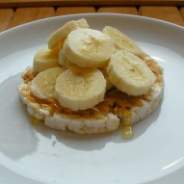
Makes 24 2-inch pancakes If you like the distinctive flavor of buckwheat, you’ll love these easily-prepared pancakes. Enjoy them with applesauce, fresh fruit, or maple syrup. 1/2 cup buckwheat flour 1/2 teaspoon sodium-free baking powder 1/4 teaspoon baking soda 1/4 teaspoon salt 1/2 cup rolled oats 1 ripe banana, cut into chunks 2 tablespoons maple syrup 1 tablespoon vinegar 1 cup soy- or rice milk 1 vegetable oil spray Stir four, baking powder, baking soda, and salt together in a mixing bowl. Place oats, banana, syrup, vinegar, and non-dairy mild into a blender. Blend until smooth, then add to the flour mixture, stirring to remove any lumps. Preheat a non-stick skillet or griddle, then lightly spray it with vegetable oil spray. Pour small amounts of batter onto the heated surface and cook over medium-high heat until the tops bubble. When the bubbles break and the edges of the pancakes are dry, turn them carefully with a spatula and cook the second sides until golden brown, 30 to 60 seconds. Serve immediately. Per pancake Calories: 29 Fat: 0.4 g Saturated Fat: 0.1 g Calories from Fat: 11.4% Cholesterol: 0 mg Protein: 1 g Carbohydrates: 5.9 g Sugar: 2 g Fiber: 0.7 g Sodium: 44 mg Calcium: 20 mg Iron: 0.3 mg Vitamin C: 0.5 mg Beta Carotene: 1 mcg Vitamin E: 0.2 mg Source: Turn Off the Fat Genes by Neal D. Barnard, M.D.; recipe by Jennifer Raymond M.S.,...
read moreBreakfast Warmer
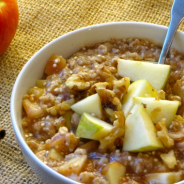
Makes 2 servings 1 1/2 cups cooked brown rice 3/4 cup chopped apples 1/4 cup apple juice 2 tablespoons maple syrup 1 teaspoon lemon juice 1/2 teaspoon vanilla extract 1/4 teaspoon ground cinnamon Place all ingredients in a microwave-safe bowl. Microwave on high for 10 minutes, stirring occasionally. Per serving (1/2 of recipe) Calories: 258 Fat: 1.5 g Saturated Fat: 0.3 g Calories from Fat: 5.2% Cholesterol: 0 mg Protein: 3.9 g Carbohydrates: 57.7 g Sugar: 20.5 g Fiber: 6.2 g Sodium: 11 mg Calcium: 37 mg Iron: 1.1 mg Vitamin C: 3.2 mg Beta Carotene: 13 mcg Vitamin E: 0.1 mg Source: Mary McDougall of the McDougall Program...
read moreBreakfast Tortilla
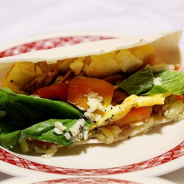
Makes 6 to 8 servings 2 cups washed and chopped fresh spinach (firmly packed) 2 cups cooked brown rice 1 cup frozen corn 1/2 cup salsa 6 – 8 whole-wheat or corn tortillas Place spinach in a saucepan with only the water you washed it in still clinging to the leaves. (If you washed the spinach the night before, place the spinach in the saucepan and sprinkle a little water over leaves.) Cook, stirring, until just wilted, about 2 minutes. Remove from the saucepan and drain well. Place rice, corn, and salsa in the saucepan. Cook, stirring, until heated through. Stir in spinach. Spoon a line of this mixture down the center of each tortilla and roll. Per serving (1/6 of recipe) Calories: 185 Fat: 2 g Saturated Fat: 0.4 g Calories from Fat: 9.6% Cholesterol: 0 mg Protein: 6 g Carbohydrates: 38.2 g Sugar: 1.9 g Fiber: 6.1 g Sodium: 279 mg Calcium: 33 mg Iron: 1.8 mg Vitamin C: 4.7 mg Beta Carotene: 628 mcg Vitamin E: 0.7 mg Source: Mary McDougall of the McDougall Program...
read moreBreakfast Teff
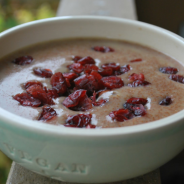
Makes 2 1-cup servings Teff, a staple grain in northern Africa for centuries, is now available in the United States. Perhaps the tiniest grain in the world, teff is extremely nutritious and makes a delicious breakfast cereal. Ask for teff at your favorite natural food store. 1/2 cup dry teff 1 1/2 cups water 1/4 teaspoon salt (optional) Combine teff and water in a saucepan. Add salt, if using, and stir to mix. Cook over low heat, stirring occasionally, until thick, about 15 minutes. Serve with fortified soy- or rice milk. Per 1-cup serving Calories: 182 Fat: 1 g Saturated Fat: 0.2 g Calories from Fat: 4.9% Cholesterol: 0 mg Protein: 4.4 g Carbohydrates: 38.1 g Sugar: 0.7 g Fiber: 6.7 g Sodium: 10 mg Calcium: 98 mg Iron: 2.5 mg Vitamin C: 0 mg Beta Carotene: 13 mcg Vitamin E: 0 mg Source: Healthy Eating for Life to Prevent and Treat Diabetes by Patricia Bertron, R.D.; recipe by Jennifer Raymond, M.S.,...
read moreBreakfast Sweet Potato Pudding
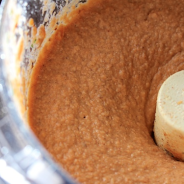
Makes about 3 1/2-cup servings This breakfast will appeal to lovers of hot cereal and porridge. It takes just moments to prepare if you have cooked sweet potatoes or yams on hand. 1/3 cup rolled oats 1/2 cup soy- or rice milk 1 cup cooked sweet potato or yam 1 tablespoon maple syrup 1/4 teaspoon cinnamon Combine all ingredients together in a blender and blend until smooth. Per 1/2-cup serving Calories: 151 Fat: 1.4 g Saturated Fat: 0.2 g Calories from Fat: 8.2% Cholesterol: 0 mg Protein: 4.6 g Carbohydrates: 31.1 g Sugar: 12.4 g Fiber: 4.2 g Sodium: 55 mg Calcium: 94 mg Iron: 1.5 mg Vitamin C: 16.8 mg Beta Carotene: 9783 mcg Vitamin E: 0.8 mg Source: Turn Off the Fat Genes by Neal D. Barnard, M.D.; recipe by Jennifer Raymond M.S.,...
read moreBreakfast Scramble 2
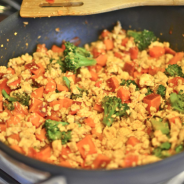
Makes 6 servings This is a cholesterol-free and low-fat way to enjoy scrambled “eggs.” Using tofu instead of eggs adds extra fiber and healthy plant protein, and turmeric makes the scramble the yellow color you’re accustomed to. 1 pound low-fat tofu 1 red bell pepper, seeded and chopped 1 green bell pepper, seeded and chopped 2 tablespoons vegetable broth 2 garlic cloves, minced 1/2 medium onion, chopped 1 teaspoon dried parsley, lightly crumbled 1/4 teaspoon salt 1/4 teaspoon black pepper 1/2 teaspoon turmeric 1 medium zucchini, chopped Press the block of tofu between two plates to remove excess liquid. Do this with a couple of paper towels between the tofu and the bottom plate and a can of vegetables or other weight on top of the top plate. Replace paper towels with new ones as they become saturated. Press tofu for at least 30 minutes—the longer, the better with 2 hours being ideal. Combine turmeric, black pepper, salt, and parsley in a small dish. Sauté onion and garlic in broth until tender. Add bell peppers and zucchini and cook until softened. Crumble tofu into skillet, sprinkle mixture with combined seasonings and cook, stirring over medium heat until heated through. Stored in a covered container in the refrigerator, leftover Breakfast Scramble will keep for up to 2 days. Per serving Calories: 86 Fat: 3.5 g Saturated Fat: 0.5 g Calories from Fat: 40.8% Cholesterol: 0 mg Protein: 6.9 g Carbohydrates: 8.7 g Sugar: 3.2 g Fiber: 3.3 g Sodium: 122 mg Calcium: 51 mg Iron: 2.4 mg Vitamin C: 49.4 mg Beta Carotene: 608 mcg Vitamin E: 0.6 mg Source: The Survivor’s Handbook: Eating Right for Cancer Survival by Neal D. Barnard, M.D. and Jennifer Reilly,...
read moreBreakfast Scramble
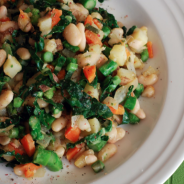
Makes 4 1-cup servings Enjoy the benefits of soy with this tofu breakfast. It’s delicious with toast andApple Chutney. 2 teaspoons olive oil or toasted sesame oil 1 small onion, chopped 2 cups sliced mushrooms 1 pound firm tofu, cut into 1/2-inch cubes 1 1/2 teaspoons curry powder 2 tablespoons reduced-sodium soy sauce Heat oil in a large non-stick skillet, then sauté onion and mushrooms over high heat, stirring often, until onion is soft, about 5 minutes. Add tofu, curry powder, and soy sauce. Continue cooking another 5 minutes. Variation: For a more elaborate scramble, add additional chopped vegetables such as carrots, celery, bell peppers, or green onions. Per 1-cup serving Calories: 119 Fat: 7.2 g Saturated Fat: 1.3 g Calories from Fat: 54.5% Cholesterol: 0 mg Protein: 10.5 g Carbohydrates: 5.9 g Sugar: 1.2 g Fiber: 2.1 g Sodium: 281 mg Calcium: 238 mg Iron: 2.7 mg Vitamin C: 2.1 mg Beta Carotene: 5 mcg Vitamin E: 0.5 mg Source: Healthy Eating for Life for Women by Kristine Kieswer; recipe by Jennifer Raymond, M.S.,...
read moreBreakfast Rice Pudding
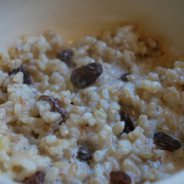
Makes 6 1/2-cup servings 2 cups cooked Always Great Brown Rice 1 1/2 cups vanilla rice milk 3 tablespoons raisins 2 tablespoons maple syrup 1 teaspoon vanilla extract 1/4 teaspoon cinnamon In a medium saucepan combine all ingredients and bring to a slow simmer. Cook uncovered, stirring occasionally, for about 20 minutes, or until thick. Serve hot or cold. Per 1/2-cup serving Calories: 140 Fat: 1.2 g Saturated Fat: 0.2 g Calories from Fat: 7.4% Cholesterol: 0 mg Protein: 2 g Carbohydrates: 30.3 g Sugar: 10 g Fiber: 2.5 g Sodium: 26 mg Calcium: 90 mg Iron: 0.5 mg Vitamin C: 0.4 mg Beta Carotene: 1 mcg Vitamin E: 0.5 mg Source: Foods That Fight Pain by Neal Barnard, M.D.; recipe by Jennifer Raymond, M.S.,...
read moreBreakfast on the Run
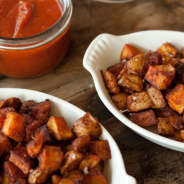
Makes 2 servings 2 large Yukon Gold potatoes 2 tablespoons ketchup or barbeque sauce 4 slices whole-wheat bread Scrub potatoes and prick all over with a fork. Microwave on high for 5 minutes. Remove and thickly slice lengthwise. Place on a non-stick griddle and brown on both sides, about 10 minutes. Toast bread. Spread 2 slices with ketchup or barbeque sauce, place potato slices on bread, and top with remaining bread. Serve at once. Per serving (1/2 of recipe) Calories: 432 Fat: 2.9 g Saturated Fat: 0.6 g Calories from Fat: 6% Cholesterol: 0 mg Protein: 13.3 g Carbohydrates: 93 g Sugar: 12.3 g Fiber: 10.3 g Sodium: 496 mg Calcium: 88 mg Iron: 5.2 mg Vitamin C: 31 mg Beta Carotene: 103 mcg Vitamin E: 0.5 mg Source: Mary McDougall of the McDougall Program...
read moreBreakfast Homefries
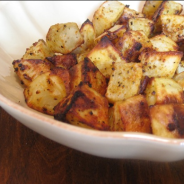
Makes 4 servings These delicious home-fried potatoes are great for breakfast or any time of day. Serve them with applesauce or try them with black bean chili and salsa! 3 russet potatoes, scrubbed 1 onion, thinly sliced 4 teaspoons soy sauce 1/2 teaspoon paprika or chili powder 1/4 teaspoon black pepper 5 – 6 cherry tomatoes, cut into quarters (optional) 2 green onions, thinly sliced (optional) Cut potatoes into 1/2″ cubes and steam until just tender, about 10 minutes. Remove from heat and set aside. Heat 1/4 cup water in a large non-stick skillet and add onion. Cook, stirring frequently, until the water has evaporated and onion begins to stick to the pan. Scrape the pan as you add another 1/4 cup water, then cook until onion once again begins to stick. Repeat this process until onion is very brown and sweet. This will take about 15 minutes. Add potatoes to onion and sprinkle with soy sauce, paprika or chili powder, and black pepper. Cook, turning gently with a spatula, until potatoes are golden brown. Garnish with tomatoes and green onions, if using. Per serving (1/4 of recipe) Calories: 128 Fat: 0.2 g Saturated Fat: 0.1 g Calories from Fat: 1.7% Cholesterol: 0 mg Protein: 3.1 g Carbohydrates: 29.9 g Sugar: 2.7 g Fiber: 4.1 g Sodium: 309 mg Calcium: 39 mg Iron: 2.7 mg Vitamin C: 19.5 mg Beta Carotene: 89 mcg Vitamin E: 0.2 mg Source: New Century...
read more